


Injection molding
of plastics
We transform technical thermoplastics into precision components with tight tolerances, excellent finishes and ISO 9001 certified quality. A single partner from mold design to delivery in Kanban logistics.
What is plastic injection molding
Injection molding is the benchmark technology for producing high-precision technical plastic components used across all major industrial sectors. The process involves melting the engineering polymer and injecting it at high pressure into a precision mold, where the material cools and takes on its final geometry.
The quality of the finished component depends on the balance between part design, mold development, material selection and process control. Injection molding is therefore not merely a production stage but an engineering activity that delivers components with high mechanical performance, dimensional accuracy, aesthetic quality and production repeatability.
At SABE we support our customers through every stage of development, from part design to industrialization and series production, turning an idea into a reliable, optimized product that is ready for the market.
The advantages of injection molded plastics
Cost efficiency
Lower total cost of the component
Injection molding delivers competitive unit costs, high repeatability and optimized production cycles, reducing the total cost of the product.
Precision
High dimensional accuracy and repeatability
Complex geometries, tight tolerances and precise fits are reproduced consistently, ensuring quality and reliability throughout the entire production cycle.
Finished components
Aesthetics straight from the mold
High-quality surfaces, textures, colors and finishes can be obtained directly in the molding process, reducing or eliminating painting, finishing and reworking operations, with significant savings in time and cost.
Mechanical performance
High-performance engineering polymers
The use of technical, high-performance materials (PA, PBT, PPS, PEEK and others) makes it possible to obtain components with mechanical, thermal and chemical characteristics comparable, in many applications, to those of metal alloys, with the advantage of lower weight and greater design freedom.
Certified and recyclable materials
Performance, compliance and sustainability
Recyclable and certified materials are available for specific applications, such as contact with food and drinking water, Flame Retardant requirements (UL94) and numerous other industry standards, combining regulatory compliance with environmental sustainability.
Light weight
Weight reduction without compromising performance
Plastics make it possible to produce lightweight components, helping to improve energy efficiency, ergonomics and ease of handling.
The production process
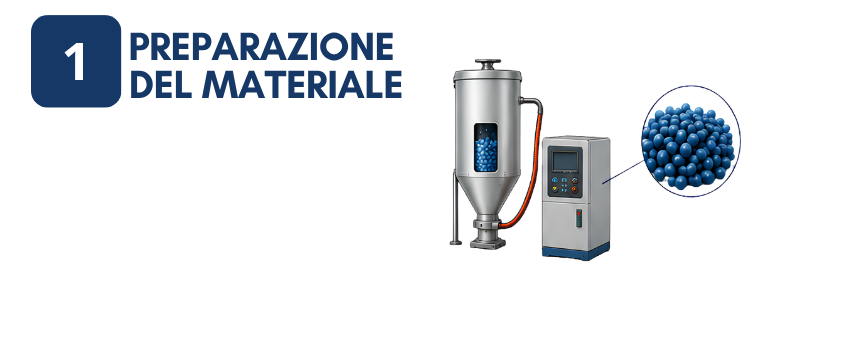
Material preparation
Before molding, the engineering polymer undergoes a drying process where required, in order to remove residual moisture that could compromise the mechanical properties, the aesthetic quality and the dimensional stability of the component.
Dryer temperature, residence time and dew point are defined according to the hygroscopic characteristics of the material (PA, PBT, PPS, PEEK, etc.), guaranteeing optimal conditions for the subsequent transformation process.
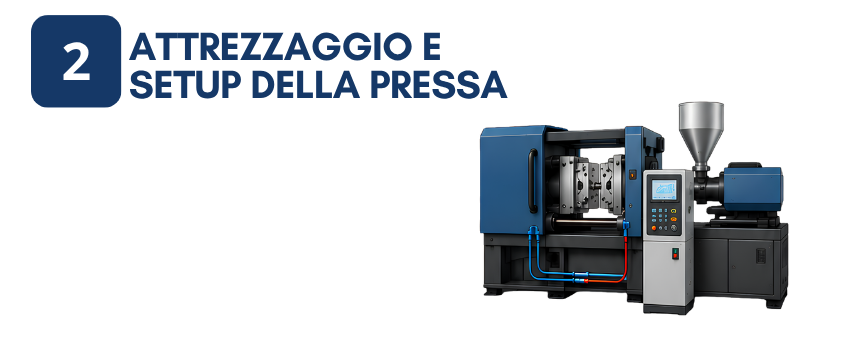
Mold installation & machine setup
The mold is installed on the injection molding machine and connected to the cooling circuits and to the temperature control unit (TCU). All the main process parameters are then set, including:
- barrel temperature profile
- nozzle temperature
- mold temperature
- clamping force
- injection speed
- injection pressure
- back pressure
- screw rotation speed
- shot size
- cooling time
Setting these parameters correctly is essential to achieve a stable and repeatable process.
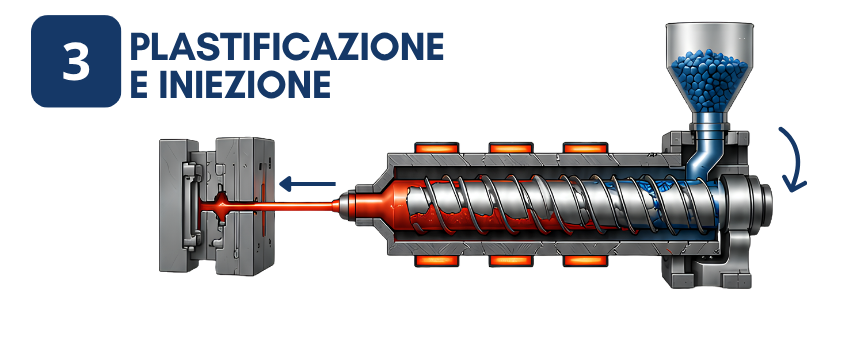
Plasticizing & injection
Plastic pellets are fed into the hopper and reach the plasticizing unit. Inside the barrel, the reciprocating screw rotates on its own axis, progressively conveying the material towards the front of the barrel.
Along this path the polymer passes through the various heating zones of the barrel, normally three or four, each set to a specific temperature according to the material being processed. The polymer melts not only through the action of the electrical heaters, but above all thanks to the energy generated by the shear heating produced by the rotation of the screw.
In functional terms, the screw is divided into three main sections:
- Feed zone, where the material is conveyed.
- Compression or transition zone, where the material is progressively compacted and begins to melt.
- Metering zone, where the material reaches a fully homogeneous state in terms of temperature, pressure and viscosity.
At the end of the plasticizing phase, the screw stops rotating and moves axially (forward stroke), acting as a piston. The molten material is then injected at high pressure through the nozzle, the sprue, the runner system and the gates, until the mold cavity is completely filled.
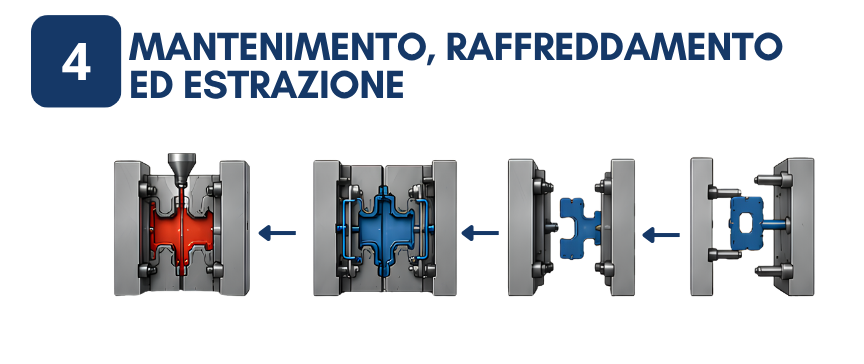
Packing, cooling & ejection
Once the cavity has been filled, the packing (holding pressure) phase begins. This phase compensates for the volumetric shrinkage of the material during solidification, ensuring the dimensional stability of the component and preventing defects such as sink marks, voids and warpage.
The component is then cooled through the mold cooling circuits until it reaches the ejection temperature. The mold opens and the ejection system automatically releases the component.
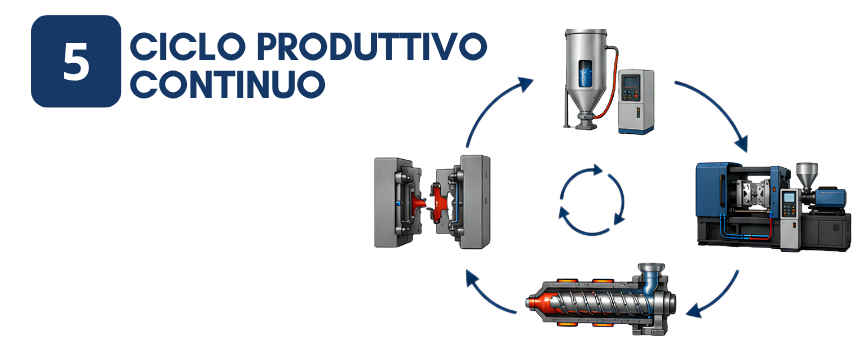
Continuous production cycle
Once ejection is complete, the mold closes again and the cycle restarts automatically. The high repeatability of injection molding comes from the continuous control of all process parameters: temperatures, pressures, speeds, cooling times and screw position.
Constant process monitoring makes it possible to produce millions of components while maintaining dimensional accuracy, mechanical characteristics and aesthetic quality unchanged.
Materials processed
We process over 196 thermoplastic and high-performance materials, selected according to the mechanical, thermal and chemical requirements of the component.